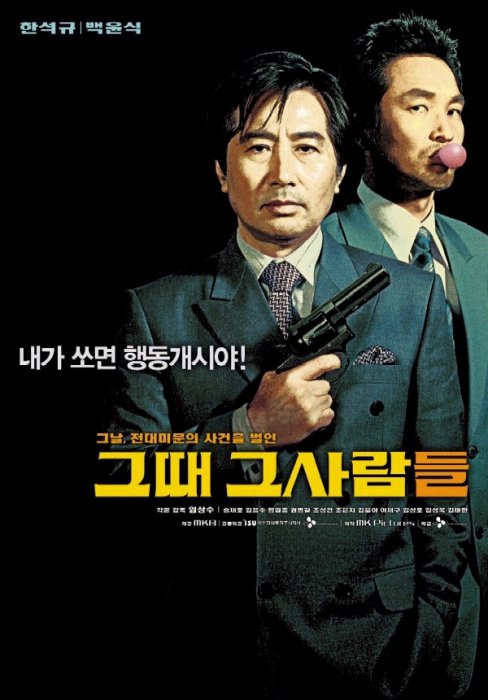
The President's Last Bang
Contents |
User Rating
Current user rating: 92/100 (2 votes)
Profile
- Movie: The President's Last Bang
- Revised romanization: Geuddae geusaramdeul
- Hangul: 그때 그사람들 / 그때 그 사람들
- Director: Im Sang-Soo
- Writer: Im Sang-Soo
- Producer: Jae-myung Shim, Chul Shin
- Cinematographer: Woo-hyung Kim
- Release Date: February 3, 2005
- Runtime: 102 min
- Production Budget: $4.5 Million
- Studio: MK Pictures
- Distributor: CJ Entertainment
- Language: Korean
- Country: South Korea
Plot
South Korean President Park Chunghee came to power via military coup in 1961 and ruled for 18 years with near dictatorial powers. In October, 1979, students and civilians called for democracy and protested Park’s oppressive rule, but Park’s military easily crushed the protesters.
On October 26, 1979, the day will go down in South Korean history as the President’s Last Bang. While the President, his chief bodyguard and Chief Secretary have dinner with two female escorts, the director of the Korean Central Intelligence Agency will attempt to assassinate the President. Director Kim of the KCIA, along with his two tops aides will now try to change history by ending the life of this charismatic political leader.
Notes
- In 2005, Ji-man Park, the only son of actual South Korean president Chung-hee Park, brought a libel lawsuit against the filmmakers for defaming of his father.
- Ji-man Park sought to suspend the opening of the film and receive monetary compensation.
- The Seoul Central Court ordered 3 minutes & 50 seconds of documentary scenes to be excised from the film and 100,000 Won awarded to Ji-man Park.
- On appeal, July 2006, the film's production company, MK Pictures received the decision to restore the film to its original state. Plaintiff appealed.
- In 2008, the lawsuit finally came to its conclusion. The Seoul High Court ordered the filmmakers to insert an explanatory title stating that the film was entirely fictional for future screenings and Ji-man Park must return 100,000 Won that he was awarded initially.
Cast
- Song Jae-Ho - President Park Chun-hee
- Han Suk-Kyu - KCIA Chief Agent Ju
- Baek Yun-Shik - KCIA Director Kim
- Jeong Won-Jung - President's Chief Bodyguard Cha
- Jo Sang-Geon
- Kim Sang-Ho - KCIA Agent Jang
- Kwon Byeong-Kil - President's Chief Secreatry Yang
- Lee Jae-Gu - KCIA Agent Kwon
- Seong-wook Kim
- Choi Dong-Hun - Army surgeon
- Sang-gun Cho - KCIA Safehouse Caretaker Shim
- Won Yung Chung
- Jo Eun-Ji - Banquet Guest
- Jeong In-Gi
- Sang-kyun Jo
- Jeong Jong-Jun
- Eung-su Kim - KCIA Agent Colonel Min
- Kim Seung-Wook - KCIA Agent Won
- Tae-han Kim - KCIA Agent Song
- Yoon-ah Kim - Singer
- Kim Yun-Ah
- Kim Byung-Ok
- Yun Yeo-Jong
- Kim Yeong-In
- Lee Jae-Gu
- Lee Dong-Yong
- Jo Jae-Yun
- Kwon Tae-Won - Restaurant Chef
- Kim Ki-Cheon
- Lee Seung-Hun
- Kim Hyeong-Il
- Jo Duk-Je - Major Jo
- Park Jin-Young - Brigadier General Kim
- Kim Ki-Hwan - bodyguard for Head of Dept. Mr. Kim
Trailer
Film Festivals
- 2012 (18th) Vesoul International Film Festival of Asian Cinema - February 14-21, 2012 - Thématique : Brûlures de l'histoire
Comments
Leave a Comment
- South Korean films
- 2005 South Korean films
- Films
- 2005 films
- Government films
- 2005 Government films
- K Government films
- Based on True Story films
- 2005 Based on True Story films
- K Based on True Story films
- MK Pictures films
- 2005 MK Pictures films
- CJ Entertainment distributed films
- 2005 CJ Entertainment distributed films


Ki Says:
Jan 16 2008 10:11 am
The President’s Last Bang is based on a true incident; the assassination of South Korean President Park Chunghee. If you are not familiar with the political background of South Korea, perhaps some of the movie’s more controversial moments will become lost in translation. First a little back ground about the the era of President Park Chunghee.
President Park Chunghee was one of the more controversial figures in Korean history. His reign over South Korea began in 1961, after a (bloodless) military coup. When he ascended to power, the country was at an extremely fragile stage. South Korea was only 8 years removed from the Korean War and featured an economy that was nearly non-existent. At the time when President Park took control of the nation, the country’s per capita income was less than a $100. By the time his reign ended, South Korea’s per capita income increased by a factor of 20 and he has been widely credited for the country’s transformation into an economic powerhouse by shifting the focus of the economy into an export-oriented economy.
Unfortunately, President Park’s 18 year tenure was also renown for his disregard for human rights and near dictatorship like control over the country. One of President Park’s first actions, after taking over the country, was the creation of the KCIA (Korean Central Intelligence Agency). The KCIA was created to prevent another military coup and to suppress all potential enemies domestically and internationally. The KCIA eventually gained near unlimited powers. They could arrest and detain any person on any charge, which resulted in a climate of of extreme fear and repression. The director of the KCIA, Kim Jae-kyu, is the person responsible for the assassination of President Park on October 26, 1979.
Not only did The President’s Last Bang criticize Park’s regime for their disregard of human rights (the film featured an impressive scene with the camera panning across various rooms in the KCIA, interrogating and torturing citizens), but also portrayed President Park as a Japanese sympathizer. The film even showed President Park speaking in Japanese with his Korean aides. If you want to rile up the blood of Korean citizens, just show one of their leaders as a sympathizer to the Japanese! Although it may be fiction that President Park spoke in Japanese with his political allies, he was trained at a military academy in Manchuria when the Japanese occupied China and he eventually normalized relations with the Japanese in 1975. This would probably be the main reasons why the film portrayed President Park as pro-Japanese.
Beyond these criticism of President Park in The Presidents Last Bang, the film also protrayed Park as a womanizer, that indulged heavily in alcohol. It should be noted that, President Park lost his wife in 1974, because of a botched assassination attempt on his life. Soon after the death of his wife, he became more withdrawn and perhaps this event led to this alleged type of behavior. There were also a few brief scenes that showed Park and his aides discussing the role of democracy in South Korean and other countries. They referred to a handful of other politcal leaders, including a President that started out as peanut farmer from rural Georgia. I really can’t say how accurate these comments were, but regardless, it was fascinating to observe the way politicians view themselves against other contemporaries.
As you can see by now, The President’s Last Bang is extremely controversial for its critical view on one of Korea’s most historical figures. Beyond the political aspects of The President’s Last Bang, the film is a gripping tale of an assassination attempt and the dreams of a small group of individuals wanting to change the status quo for the betterment of their country.
The ensemble cast was impressive all throughout. Baek Yun-Shik, who played the the KCIA director responsible for the assassination of the President, stood out the most for his realistic portrayal of a government official fed up with politics and wanting to make a change because of that. Han Suk-Kyu gave perhaps his finest performance ever, as one of Director Kim’s top aides in the assassination attempt. I should also make a note about Eun-ju Ho who played the escort that was with the President during the assassination attempt. As always she was charming, but in every film I have seen her in (Afrika, Who Are You?, My Scary Girl and now the President’s Last Bang) she has always played a prostitute or a variation of one! I’m starting to get the impression that she is typecast?
The President’s Last Bang not only provided a gripping tale of the night of the assassination, but the film featured impressive flowing camera work, that really helped give the viewer a more intimate view on how the assassination occurred. The long pans across the building where the President was having dinner was as appealing aesthetically as it was informative. As much as the movie injected its own political views into the events leading up to the assassination, once the attempt was started, the film actually took on a near neutral/documentary like view on the events afterward.
If you like political dramas then check out The President’s Last Bang. The film is stylistic, (politically) sensational, and unique for its use of comedy & action in portraying a real life event. Fascinating from start to finish, The President’s Last Bang is the kind of film that I can watch many, many, many times.